









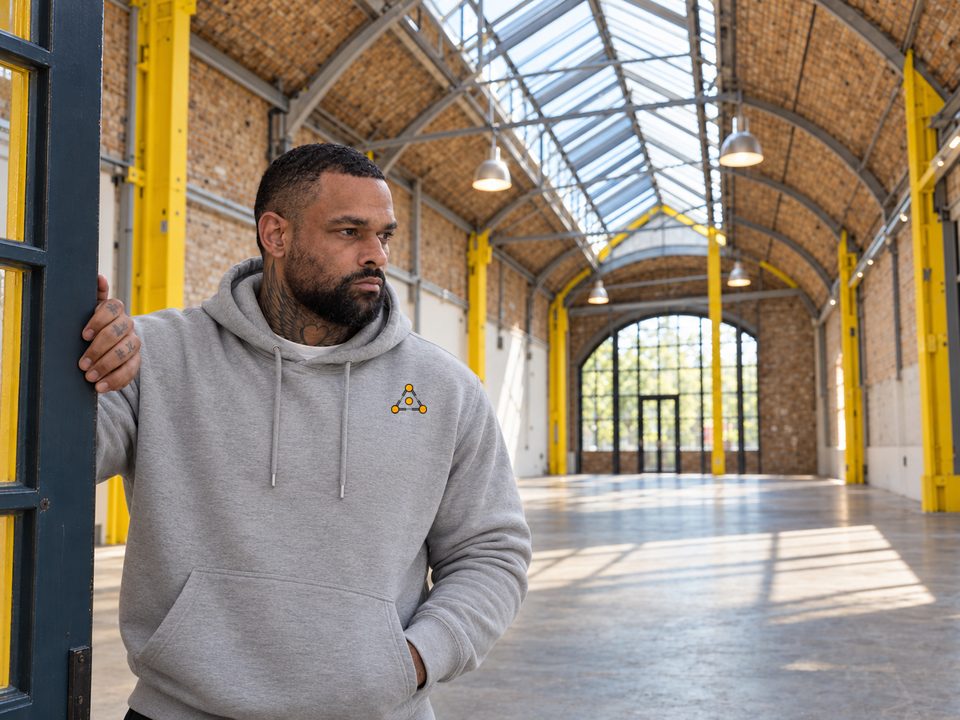
An open, yellow-framed door into a bright, empty workshop (an illustrative image made with AI). Skip the doorway

A social experiment, built in public.

Can a business built on four simple rules make room for the people the system leaves out?

A social experiment, built in public.

Can a business built on four simple rules make room for the people the system leaves out?

TLEP
BuildingRE:KONNECT
NowPaid work
NextRE:SKILL
Open BookLive

01 / What this is

Four rules.
One test.

The Lived Experience Project is a social enterprise and a social experiment, built in public in London.

In game theory's most famous tournament, the strategies that kept winning were nice, responded, forgave and stayed clear. Too much of society runs on the opposite, and we think that is why the same problems keep coming back. So we are building a business on those four rules, in the open, to see if it works.

We need you. Do you want to see change? Will you be part of it?

  • WhatA social enterprise, and a social experiment.
  • WhyFour rules that win in game theory are missing from society.
  • WhereLondon, starting with RE:KONNECT.
  • WhenNow. Built in public, step by step.
  • WhoThe founder builds it now. Young people and people with lived experience next. And you.

How? Four stages, next.

The four stages

Four stages.
One shared purpose.

Each stage opens when the one before can help pay for it. RE:KONNECT comes first, and what it earns helps fund RE:SKILL.

  1. 01 · ReconnectMore cities later

    RE:KONNECT, London

    Stage 1 · being built now

    London, connected. Real opportunities, rated by the people who use them.

    • Organisations are interviewed before they post. No fake jobs.
    • Pay and conditions up front, rated by the people who use them, not by tick boxes.
    Join RE:KONNECT early
  2. 02 · Reskill

    RE:SKILL

    Stage 2 · opens when it is funded

    Web and digital skills, learnt on real projects.

    • Web and digital skills only, taught properly, on real projects.
    • In our space or yours. Want something we don't teach? RE:KONNECT finds who does.
    Host or ask about RE:SKILL
  3. 03 · Regenerate

    RE:GENERATE

    Stage 3 · the goal

    The Hub: a workplace of our own.

    • A co-working space and business base in London.
    • Businesses and people learning, under one roof.
    Offer a space
  4. 04 · Re-enter

    RE:ENTRY

    Stage 4 · future · not open for referrals

    Real jobs, after prison.

    • The last stage: real, paid jobs inside the Hub for people leaving prison.
    • Before prison and after it, with lived experience at its centre.
    Explore a partnership

What we're funding next

A room.
The kit.
A start.

What the next step needs, what each thing is for, and what it costs. RE:KONNECT first, then the first RE:SKILL group.

£0 set asideof £24,883.55

Set aside in the wish list pot: a share of every paid job after running costs, plus memberships and any gifts. How the money moves. Prices checked on 19 October 2026 from published sources, for the founder to confirm. Real quotes replace them as they come in.

  1. A desk to build from

    A dedicated desk in a council-backed social enterprise hub in Elephant and Castle for a year, so the work happens away from home. Got a space we could use for free? Even better.

    £170 a month, a subsidised rate that needs approval, x 12. The Enterprise Hub (opens a new tab)

    £2,040
  2. Running RE:KONNECT for a year

    Hosting, the database and sign-in, a small server that checks uploaded files, and the domain, for the app being built first.

    Supabase Pro £267.54 + Cloudflare Workers £53.51 + a 4 GB server £47.66 + domain £15.45, with VAT; email and monitoring on free plans. Supabase pricing (opens a new tab)

    £384.16
  3. Legal fees

    Legal advice for the first year.

    £480 fixed fee + 4 hours at £360 from an SRA-regulated firm, plus VAT. Singleton Solicitors (opens a new tab)

    £2,304
  4. Insurance for the first year

    Public and employer's liability, professional indemnity and cyber cover.

    £79.80 + £82.75 + £155.84, published starting prices, not quotes. Simply Business (opens a new tab)

    £318.39
  5. Data protection fee

    The ICO registration every organisation that holds people's data must pay.

    Tier 1, £47 a year by direct debit (£52 otherwise). ICO, data protection fee (opens a new tab)

    £47
  6. Six MacBook Pros for the first RE:SKILL group, Top-end kit: the best tools for the job, not the cheapest

    Machines that run AI tools on the laptop itself and handle design work. Not the cheapest: the ones that work.

    (£3,099 MacBook Pro 14-inch, M5 Pro, 48GB memory, 1TB + £79 power adapter) x 6. Apple UK (opens a new tab)

    £19,068
  7. AI tools and data for six learners, 12 weeks

    An AI tool and a data SIM for each learner while they learn.

    (£18 Claude Pro + £10 data) a month x 3 months x 6. Claude pricing (opens a new tab)

    £504
  8. Safeguarding before anyone joins

    Checks and training before anyone young joins: an enhanced DBS check, a lead trained to Level 3, and a basic course for two others.

    Enhanced DBS £65 all-in + Update Service £15 + Level 3 lead £78 + two NSPCC courses £60. GOV.UK, DBS fees (opens a new tab)

    £218
  9. Total to aim for£24,883.55

02 / The loop

The loop.

A circular economy, tested in the open.

Can useful work, open books and people's help keep making room for the next person? That is the test.

  1. Step 01of 04

    Paid work.

    Solve something useful. Websites, apps and creative projects for organisations, with a clear brief and a fair price.

  2. Step 02of 04

    Open Book.

    Show the working. Publish what comes in, what it costs and what is left for the mission.

  3. Step 03of 04

    Room to try.

    Make the opportunity. Real briefs, tools and support, with room for young people to choose what interests them.

  4. Step 04of 04

    Back round.

    Help comes back. Kit, time and skills from people who want to help, and from the people the room has helped. Then it goes round again.

Paid work now. Supported youth learning is the next stage, once the people, facilities and resources are ready.

Move across a picture to go from the idea, to now, to the goal. On a phone, tap it.

01 · Paid work
Idea, illustrative: Sketch of a paid brief: a client and two makers round a table with a laptop.Proving it: the founder pinning up page designs in a rented office. Made with AI from his own photos, with his consent.Goal, illustrative: A young man presents a website on a big screen to a community organisation manager and another young adult.
The ideaUseful briefs for organisations, at a fair price.
02 · Open Book
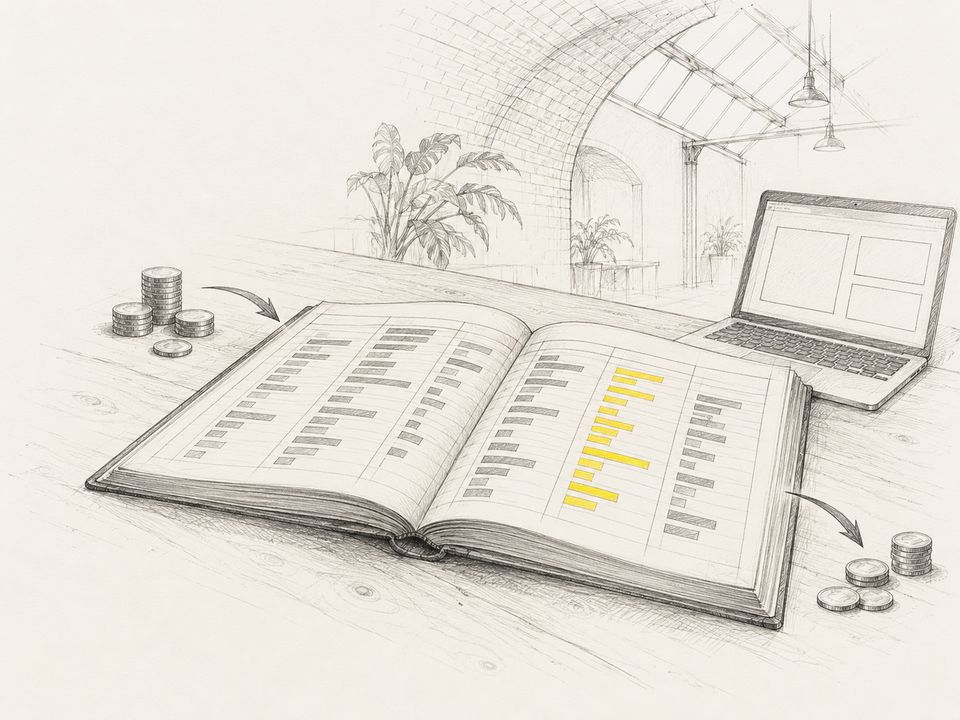
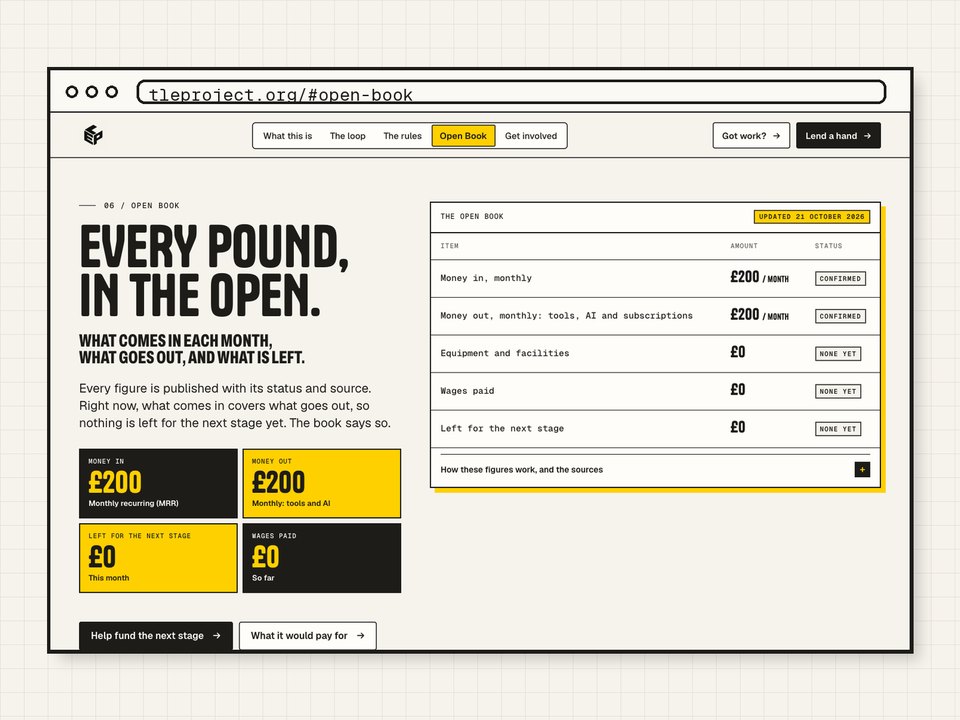
Idea, illustrative: Sketch of an open ledger with money coming in and going out.Proving it: a screenshot of the Open Book on this site: £200 in and £200 out each month, no wages paid and nothing left yet.Goal, illustrative: Two young adults review a bar chart of the figures on a large screen.
The ideaEvery pound published: what comes in, what it costs, what is left.
03 · Room to try
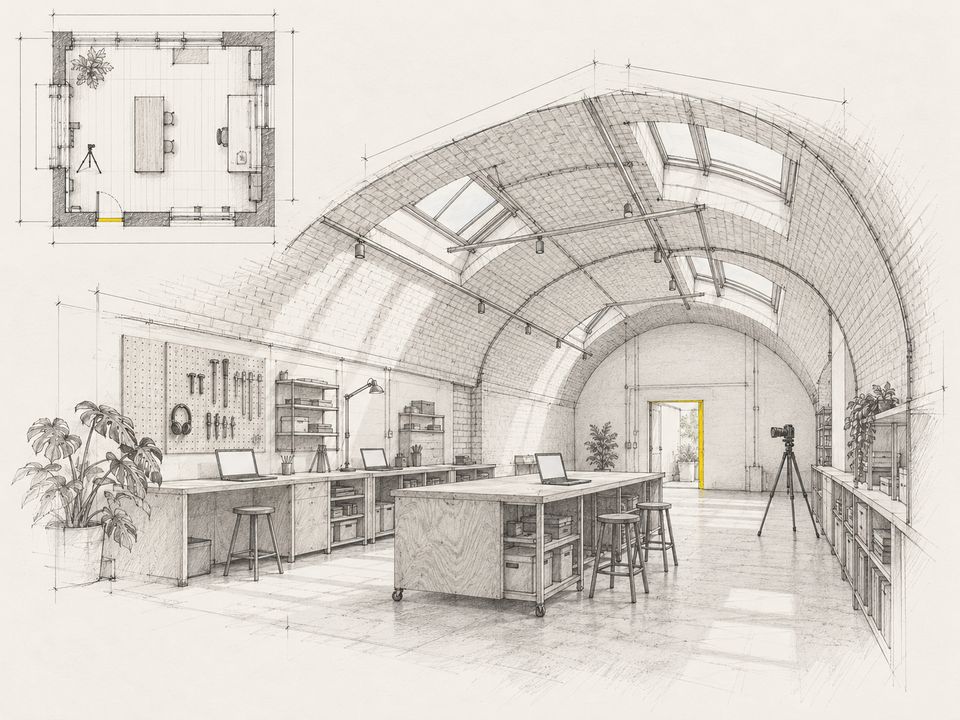
Idea, illustrative: Measured sketch of an empty workshop with benches, laptops and tools.Proving it: the founder at the door of the empty room, looking in. Made with AI from his own photos, with his consent.Goal, illustrative: A young adult edits a short video at a workbench.
The ideaA real room with tools and support to try real briefs.
04 · Back round
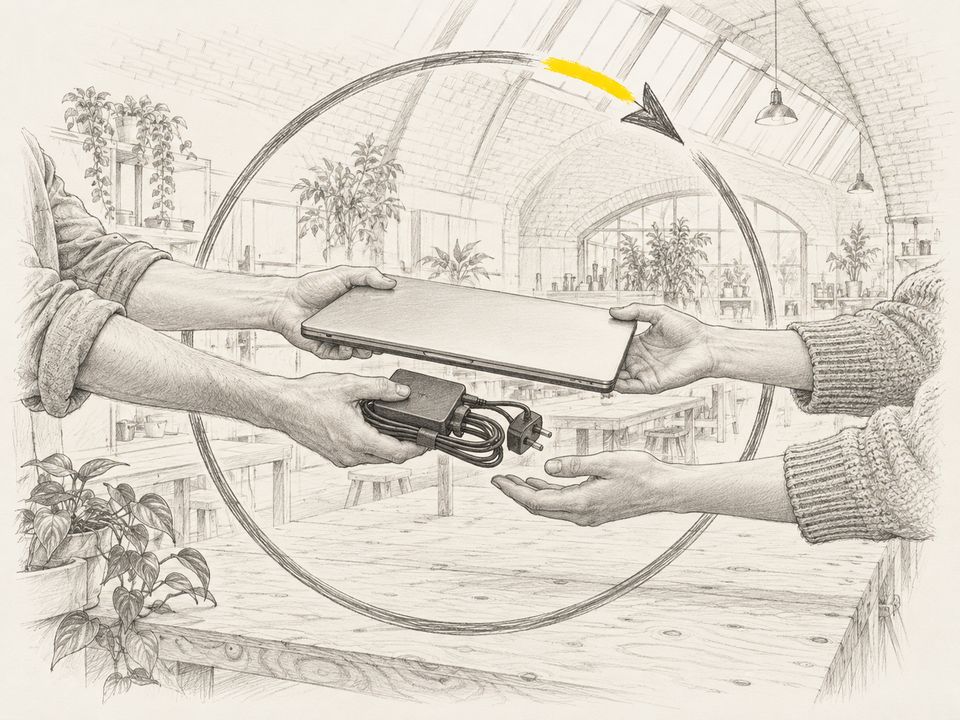
Idea, illustrative: Sketch of hands passing on a laptop, inside a circular arrow.Proving it: the founder carrying in a crate of donated laptops. Made with AI from his own photos, with his consent.Goal, illustrative: The same young man, now teaching three other young adults round two laptops.
The ideaKit, time and skills come back round to the next person.
Image information

The pictures of people and places on this site are made with AI. Sketches and goal pictures are illustrative: the people in them are not real and are not TLEP participants. The founder's pictures are made from his own photos, with his consent. The Open Book picture and the work examples are screenshots of real work.

The goal: real opportunities, and real access to them.

Experience that makes people want to find their place. We don’t believe anyone wants to work just for the sake of working, and it is unfair to expect it when everything else in life is hard.

  1. Now

    Founder-led paid work, proving the loop can fund itself.

  2. First

    Young adults who are not in education, employment or training, or who are disadvantaged; and young people at risk of exclusion from school who are neurodivergent (such as ADHD, autism or dyslexia), diagnosed or not.

  3. Next

    People in the justice system. Prevention and intervention through access and opportunity, to cut offending and reoffending, so people, their families and their communities do better.

Not temporary jobs to tick boxes: skills, opportunity and experience towards a career people actually want. Work with anyone under 18 starts only once child safeguarding is in place.

03 / Our loop theory

Why a loop?
The rules of
the game.

Our loop theory:
what goes round, comes round.

When the same people meet again and again, how you treat each other comes back to you. That makes life a repeated game, and a repeated game has rules.

Picture a simple game. Each round, two people choose: cooperate (play fair) or take (grab more for yourself). In 1980 a famous tournament asked: what is the best way to play, when you keep meeting the same people? The winner was the simplest strategy of all: Tit for Tat. Watch how it plays.

Tit for Tat against a player who takes once in round 3
Round1234567Total
YouTit for TatCooperate, +3Cooperate, +3Cooperate, +0Take, +5Cooperate, +3Cooperate, +3Cooperate, +320
ThemTakes onceCooperate, +3Cooperate, +3Take, +5Cooperate, +0Cooperate, +3Cooperate, +3Cooperate, +320

  1. Round 1. You start fair. So do they. 3 points each.
  2. Round 2. Still fair. 3 each.
  3. Round 3. They take. You played fair, so you get 0 and they get 5.
  4. Round 4. You respond straight away: you take back. Now they get 0. Taking from you did not pay.
  5. Round 5. They played fair last round, so you forgive. Back to fair, 3 each.
  6. Round 6. Fair again. 3 each.
  7. Round 7. You both finish on 20. Taking got them nothing extra, and you never let it slide.

CCooperate: play fairTTake: grab more for yourself+3Points that round

  1. Be nice.

    Start fair.

  2. Respond.

    Respond straight away.

  3. Forgive.

    Then forgive.

  4. Be clear.

    Be easy to read.

Responding is not violence. It means not letting harm pass: straight away, once, and in proportion. Then forgiving. That is how the loop is built.

See the whole game, and play it

04 / Make room together

Got something you could share?

Lend it to the build.

A desk for a day, a laptop, internet access, AI tools or an hour of your skills. Right now your skills help the founder build it; next, they help young people learn.

They tick themselves as you scroll. Untick anything you can’t offer.

What you could offer

Quantities, suitability and arrangements are confirmed before anything changes hands.

Got a space?
Get in touch.

There’s nowhere to come and see yet: we’re looking for a space to work from. If you can offer one, or any of these, email us.

info@tleproject.org

Email to start a conversation. We use what you share to reply and discuss your offer. Please leave out bank details and information about young people. About your information.

Businesses: got a corporate social responsibility budget? Put it where young people can feel it. Talk to us about CSR

How lending works

From your hands
to the build.

  1. Tell us what you could share, and when.
  2. We agree it: what suits, how it gets here, any terms.
  3. It goes to work in the build, and it’s listed in the Open Book.

05 / Paid work

Work with us.

Got something that needs solving? Bring a real brief: a monthly retainer or a one-off job. We'll scope the work, agree a price and show what it contributes.

SheetWebsites
ExampleEast Kent Mavericks · CCF · Coastal Studio · theonecoleman.co.uk
PriceScoped per brief

Sites that help people find you and take the next step: a 3D story for a sports club, a client site still to launch, a calm studio concept and the founder’s own site.

SheetApps and tools
ExampleKONTROL · Vindx · TR[1]BE app · Publish Studio
PriceScoped per brief

Focused apps built around a real problem: KONTROL for getting things done, Vindx for making images and video, a coaching app and Publish Studio for sharing.

SheetCreative work
ExampleEcho Espresso · Wear Evelyn · The loop drawings
PriceScoped per brief

Photography, motion and drawing: content for a coffee shop, a campaign for a fashion brand and the drawings on this site.

Bring a real brief.

Tell us about your project

Community organisations can tell us what they can afford. Scope and price are agreed before work starts.

06 / Open Book

Every pound,
in the open.

What comes in each month, what goes out, and what is left.

Every figure is published with its status and source. Right now, what comes in covers what goes out, so nothing is left for the next stage yet. The book says so.

Money in£200Monthly recurring (MRR)
Money out£200Monthly: tools and AI
Left for the next stage£0This month
Wages paid£0So far
The Open BookUpdated 21 October 2026
Every row, with its status and source
Open Book figures. Status and sources for each row.
ItemAmountStatus
Money in, monthlyComing in each month. Confirmed by the founder, 19 October 2026.Confirmed
Money out, monthly: tools, AI and subscriptionsTools, AI subscriptions and other software the build runs on. Confirmed by the founder, 19 October 2026.Confirmed
Equipment and facilitiesNo equipment or facilities yet. The wish list shows what is needed. Confirmed by the founder, 19 October 2026.None yet
Wages paidNo wages have been paid yet: money out is tools only. Confirmed by the founder, 19 October 2026.None yet
Left for the next stageWhat comes in covers what goes out, so nothing is left for the next stage yet. Confirmed by the founder, 19 October 2026.None yet
How these figures work, and the sources

Money in and money out are monthly figures. What comes in pays for the tools; there is no equipment or space yet, no wages have been paid and nothing is left for the next stage.

Wages are what the work is worth. Running TLEP is paid the minimum wage, and never more, whoever does it. Grants, donations and government money can pay that, and the staff and young people a grant is for, but never the founder’s specialist work, which is paid only from what it earns.

Not every pound that comes in is free for the mission: delivery costs, taxes, liabilities and reserves come first. No raw bank activity or personal financial details are published.

Download the source data. Last reviewed: 21 October 2026.

Where each pound goes

Costs first.
Then a fair split.

Every pound from paid work goes round in the same order, every month. The Open Book shows each step as it happens.

  1. Paid work comes in

    Websites, apps and creative work for organisations.

  2. Running costs first

    Tools, insurance and fees: what keeps it going.

  3. Wages for the work Whoever did the work. Today that’s the founder; as people join the work, it’s them too.

    What the work is worth, once the money is there to pay it.

  4. The wish list pot

    What is left. This is the “set aside” figure on the wish list.

Example: a £1,000 job, in a month with £400 of running costs

Of £1,000: £400 running costs, £300 in wages for the work and £300 into the wish list pot.

Wages

Fair wages.
One promise.

People are paid fairly for the work they do. Skilled work is paid at its level, and a minimum wage job is paid the minimum wage. Running TLEP is paid the minimum wage, and never more: leading it, managing it, the admin and the day-to-day, whoever does them. So far, no wages have been paid.

What the founder believes

A leader leads by example. Running an organisation should be paid what everyone else is expected to take: the minimum wage, which is the National Living Wage of £12.71 an hour for anyone 21 or over, from April 2026. He doesn’t accept that leading and managing people is worth £80,000 or £100,000 a year, he believes trustees shouldn’t be paid at all, and he thinks every organisation should work this way.

Specialist work is different. Someone who brings money in with their own skills, like the founder’s websites and apps, can be paid what that work is worth, from what it earns. Grants, donations and government money are given to help the programme, not to buy a service. So they can pay the minimum wage for running TLEP, and the staff and young people a grant is for, but never the founder’s specialist work. TLEP is starting to apply for grants and government funding, and every pound will show in the Open Book.

“The management, the day-to-day stuff… is only ever going to be minimum wage, because that’s what we expect other people to take. Grant funding isn’t being given for a service. Grant funding is being given to be able to help the programme.”

The founder, a personal commitment

What each stage costs

Costs, stage by stage.

Estimates from published prices, checked on 18 October 2026. Different from the wish list: this is what each stage costs to run once it opens. Staff time is costed at the National Living Wage, the legal minimum, so these are the least each stage could cost; wages will be what the work is worth. Real quotes and real bills replace them.

  1. Stage 1RE:KONNECT£384a year to run the app
    What’s in it

    Hosting, database and sign-in, a file-checking server and the domain, with VAT. Plus about £51 of time to vet each organisation and 2 to 8 hours a week of moderation: £1,322 to £5,287 a year at the National Living Wage.

    Supabase, Cloudflare, OVHcloud and GOV.UK prices (opens a new tab)

  2. Stage 2RE:SKILL£1,598per learner, for 12 weeks
    What’s in it

    With the MacBook Pros shared over three groups of six. The first group costs about £22,300 including the machines; after that it is teaching time at the National Living Wage, AI tools, data, safeguarding and insurance.

    Apple, Claude, giffgaff, GOV.UK and NSPCC prices (opens a new tab)

  3. Stage 3RE:GENERATE£2,400a year for one desk
    What’s in it

    A dedicated desk in South London is £200 to £396 a month. A space of our own (1,000 sq ft) is £17,110 to £42,000 a year in rent alone, before rates, energy and insurance.

    South London co-working prices and council market reports (opens a new tab)

  4. Stage 4RE:ENTRY£32,233a year for each job
    What’s in it

    At least the National Living Wage for 37.5 hours a week (£24,784.50), a workplace pension and a mentor for a day a week.

    GOV.UK, HMRC and The Pensions Regulator (opens a new tab)

  5. Every yearRunning the CIC£674a year at the least
    What’s in it

    Companies House £50, the CIC report £15, the data protection fee £47 by direct debit and an accountant from £562.

    Companies House, ICO and accountants' published prices (opens a new tab)

07 / Building a tool

KONTROL,
in public.

A workspace for getting things done.

KONTROL is the workspace the founder is building: a task manager designed with neurodivergent people in mind, with AI built in. It already runs his own work, and it will be part of the membership.

Built so far: five things that work today
  • Projects and tasks as a list, board, timeline or gallery
  • Routines with reminders, and a morning check-in: what’s your priority today?
  • Gentle tracking: no streaks to break, no leaderboards, scores kept private
  • Make it yours: text size, calm colour themes, hide what you don’t need
  • A daily AI briefing, and an alert when something needs you
Coming next: three things being built
  • Agents with one clear job, their own history and a pause button
  • Automations with approvals and a test mode
  • An inbox that sorts messages into projects
In development

See KONTROL

Share a problem or join the interest list

Nothing is sent until you choose to. Expressing interest is separate from a paid membership. There are no charges or delivery promises here.

08 / Updates

Building it
in the open.

What we're working on, and what's coming up.

Follow the build as it happens: the work, the costs, what works and what needs another try. Video updates go up on YouTube and are linked here.

Every updates email includes a one-click unsubscribe link.

22 October 2026 / Update 04

Running it: the minimum wage.

A change to the wages promise. Running TLEP, the leading, managing, admin and day-to-day, is paid the minimum wage and never more, whoever does it. Grants, donations and government money are given to help the programme, not to buy a service: they can pay that minimum wage, never the founder's specialist work, which is paid only from what it earns. TLEP is starting to apply for grants and government funding.

21 October 2026 / Update 03

Wages, and one promise.

Pay in the Open Book became one line: wages. Whoever does the work is paid what it is worth, not just the minimum wage. The promise about grants changed on 22 October: see "Running it: the minimum wage."

18 October 2026 / Update 02

Four stages, one plan.

The plan is now four stages: RE:KONNECT first, then RE:SKILL, the Hub (RE:GENERATE) and RE:ENTRY. The Open Book shows what comes in, what goes out and what is left.

16 October 2026 / Update 01

Show the working.

The build is self-funded for now. The test is whether useful paid work and community support can resource the mission.

Coming up

  • Video updates from the build
  • RE:KONNECT: the first organisations
  • Open Book: the next month's figures

09 / Get involved

Be part of it.

Four ways in. Pick the one that fits.

01 · Give us a job

Got a problem? Tell us.

A website, an app or tool, creative work, or something you can’t name yet. Tell us what’s in the way and we’ll come back to you.

What do you need?
Who is it for?

A business: A paid service. The founder does the work himself, scoped and priced up front, as a one-off job or a monthly retainer. It is also how TLEP is funded.

A non-profit or community group: Tell us what you can afford, even if that's nothing. We'll talk it through and agree the scope before anything starts.

We email you a copy with what happens next. Please leave out bank details and information about young people. About your information.

02 · Membership

Pay what you want.

Back the build every month and use the apps we make to run your own work better. Every pound shows up in the Open Book.

Coming soon
  • Freefor small non-profits, CICs and social enterprises that need it.
  • Months freefor small businesses. Startups may stay free until they make a profit.
  • The regular feefor larger charities and businesses, and more if you want to back the build.
  • No lock-inLeave whenever you like.

Prices aren’t set yet. It opens once the payments, terms and apps are ready: KONTROL first.

Tell me when it opens

04 · Lend a hand

Share kit, space or skills.

A desk, a laptop, internet access, AI tools or an hour of your time.

See what’s needed

10 / Questions

Questions.

01The four rules

What are the four rules?

Be nice: start fair and never take first. Respond: don't let harm pass, straight away, once, and in proportion. Forgive: when they go back to playing fair, so do you. Be clear: be easy to read, so trust can form. In game theory's most famous tournament, the strategies that kept winning followed these four.

Why build a business on them?

Too much of society runs on the opposite: take first, punish hard, never forgive, keep it vague. We think that is why the same problems keep coming back. So we are testing, in the open, whether a business that follows the four rules can make room for people the system leaves out.

02Why this could work

What do you mean by a circular economy?

Value goes round instead of out. Paid work funds the room, the room makes opportunities, and the people, skills and kit it gathers feed back into the work and into the next person's chance. Donated equipment is checked and reused rather than thrown away.

Isn't this a radically different way of doing it?

Yes, on purpose. Most programmes measure outcomes that tick boxes. We ask the people using a service to rate it, publish every pound, and grow one stage at a time, only when the stage before can help pay for it. If it doesn't work, you will see that in the open too.

Why should it work when other things haven't?

Because the rules reward the right things. When the same people meet again and again, fairness spreads, and taking stops paying. That is what the tournament showed, and what the town on the rules page shows. We are testing whether it holds in real life.

03Money and wages

How does paid work support the mission?

The founder does paid work for organisations: websites, apps and creative work. That money pays the running costs first, then wages for the work. What is left goes into the wish list pot for the next stage, and the Open Book shows how much. Not every pound that comes in is free to spend on the mission.

Who gets paid, and how much?

Whoever does the work is paid fairly for it. Skilled work, like building a website, is paid at its level, and a minimum wage job is paid the minimum wage. Running TLEP is paid the minimum wage, and never more: leading it, managing it, the admin and the day-to-day, whoever does them. No wages have been paid yet, and every wage will show in the Open Book.

Will the founder be paid from grants or donations?

Only the minimum wage, for running TLEP, and never more. Grants, donations and government money are given to help the programme, not to buy a service, so they never pay for the founder's specialist work: that is paid only from what the work earns. Staff and young people can be paid from a grant when the grant is for that. TLEP is starting to apply for grants and government funding, and every pound will show in the Open Book.

Can I donate or support it monthly?

Soon. A pay-what-you-want membership is being worked out, giving access to the apps we make. Prices aren't set yet. Small non-profits, CICs and social enterprises that need it won't pay; larger charities and businesses pay the regular fee and can pay more to back the build. There's no lock-in. The site takes no payments yet. TLEP is a community interest company, not a charity, so Gift Aid can't be added.

Why is membership free for some organisations?

Big charities get the big software discounts; small CICs and social enterprises usually don't. We'd rather cooperate than take: organisations that can pay, do, and the ones that can't still get the tools. Small businesses get their first months free, and we're looking at keeping startups free until they make a profit.

04Young people, learning and the law

Are young people joining the programme now?

Not yet. Supported learning (RE:SKILL) is the next stage. This build is getting the paid work, resources, facilities and support in place first. It is not a live enrolment service, and work with anyone under 18 starts only once child safeguarding is in place.

Will young people do real work for free?

No one will be used as free labour. People learn on real projects. When someone does paid work, they are paid what the work is worth, and never less than the minimum wage. Before RE:SKILL opens, we will take legal advice on how learning on real projects is set up.

Who is it for first?

Young adults who are not in education, employment or training, or who are disadvantaged; and young people at risk of exclusion from school who are neurodivergent, diagnosed or not. Later, people in the justice system, through RE:ENTRY.

05The plan

What are the four stages?

RE:KONNECT, a vetted London opportunity network (being built now); RE:SKILL, web and digital skills learnt on real projects; RE:GENERATE, the Hub, a co-working space of our own; and RE:ENTRY, real jobs in the Hub for people leaving prison.

What is KONTROL?

The workspace the founder is building: a task manager designed with neurodivergent people in mind, with AI built in. Projects, routines, reminders and a morning check-in work now; agents and automations come next. It will be part of the membership.

Can I give equipment, space or time?

Yes, start a conversation at info@tleproject.org. We are looking for a space to work from right now. Suitability, collection and loan terms are agreed first. Please do not send personal data left on old equipment.

06We don't have all the answers

Have you got it all worked out?

No. We are building it as we go, out in the open, and working with people to make sure we deliver the best service we can. If you have a question, ask us. If you work in this area and want to support it, jump in and help.

Got a question we haven’t answered? Ask us. We’d rather be asked than guessed about.

Ask a question

The whole build

info@tleproject.org

We use what you send to reply, and email you a copy. About your information.

Screenshots of real work. Client work is shown with the client’s agreement.